
Inconel Machining: Guide, Types, and Difficulties
Inconel, a family of nickel-chromium-based superalloys, is widely used in industries such as aerospace, marine, and chemical processing due to its exceptional resistance to high temperatures, corrosion, and oxidation. However, machining Inconel presents significant challenges due to its unique material properties. This guide provides a detailed, technical overview of Inconel machining, including alloy types, machining techniques, specific parameters, and key difficulties, offering a structured approach for professionals seeking to achieve precision and efficiency.
Understanding Inconel Alloys
Inconel alloys are primarily composed of nickel (50-72%), chromium (14-21%), and other elements like iron, molybdenum, niobium, and titanium, depending on the grade. These alloys are designed for extreme environments, offering high tensile strength, fatigue resistance, and stability at temperatures up to 1000°C. Common grades include Inconel 600, 625, 718, and X-750, each with specific compositions and applications.
| Alloy | Composition (%) | Key Properties | Applications |
|---|---|---|---|
| Inconel 600 | Ni >72, Cr 14-17, Fe 6-10 | High corrosion resistance, good weldability | Chemical processing, heat treatment |
| Inconel 625 | Ni 58-71, Cr 20-23, Mo 8-10, Nb 3.15-4.15 | Excellent fatigue strength, oxidation resistance | Marine, aerospace, turbine blades |
| Inconel 718 | Ni 50-55, Cr 17-21, Fe balance, Nb 4.75-5.5 | High strength, good creep resistance | Jet engines, gas turbines |
| Inconel X-750 | Ni >70, Cr 14-17, Fe 5-9, Ti 2.25-2.75 | High strength at elevated temperatures | Aerospace, springs, fasteners |
Machining Techniques for Inconel
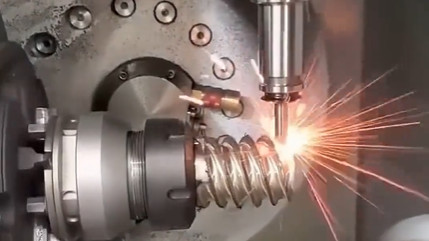
Machining Inconel requires specialized techniques to address its high strength, low thermal conductivity, and work-hardening tendencies. The following CNC machining methods are commonly used, each tailored to specific applications and component requirements.
Turning
Turning is used to create cylindrical Inconel components, such as shafts or turbine disks. Carbide tools with a positive rake angle (10-15°) are recommended to reduce cutting forces. Cutting speeds typically range from 10-30 m/min for roughing and 20-40 m/min for finishing, with feed rates of 0.1-0.3 mm/rev. Depth of cut should be kept between 0.5-2 mm to minimize heat buildup. High-pressure coolant (70-100 bar) is essential to dissipate heat and extend tool life.
Milling
Milling Inconel involves removing material to create complex geometries, such as slots or pockets. Use four- or five-flute carbide end mills with TiAlN coatings for better heat resistance. Recommended parameters include a cutting speed of 15-25 m/min, feed rate of 0.05-0.15 mm/tooth, and axial depth of cut of 0.3-1 mm. Climb milling is preferred to reduce tool wear and improve surface finish. High-pressure coolant or minimum quantity lubrication (MQL) can enhance chip evacuation.
Drilling
Drilling Inconel is challenging due to its tendency to work harden during pecking cycles. Use cobalt-grade or carbide drills with a 135° point angle and polished flutes. Cutting speeds should be 10-20 m/min, with feed rates of 0.02-0.08 mm/rev. Avoid pecking to prevent work hardening; instead, use continuous feed with high-pressure coolant (50-70 bar) to clear chips and reduce thermal damage. For deep holes, use parabolic flute drills to improve chip evacuation.
Electrical Discharge Machining (EDM)
EDM is a non-traditional method ideal for intricate Inconel components, as it avoids direct tool-workpiece contact, reducing work hardening and tool wear. Wire EDM uses a brass or copper wire (0.1-0.3 mm diameter) with deionized water as the dielectric. Sinker EDM is suitable for complex cavities, using graphite or copper electrodes. Parameters include a pulse-on time of 10-50 µs, pulse-off time of 20-100 µs, and current of 10-30 A, depending on the desired material removal rate (MRR).
Key Difficulties in Inconel Machining
Inconel’s properties, while advantageous for end-use applications, create significant machining difficulties. Understanding these challenges is critical for selecting appropriate tools and parameters.
High Work Hardening
Inconel alloys harden rapidly during machining due to plastic deformation, increasing surface hardness by up to 20-30%. This phenomenon accelerates tool wear and complicates subsequent cuts. To mitigate this, use sharp tools, maintain constant feed rates, and avoid dwelling or interrupted cuts. Machining in the solutionized state (e.g., AMS 5662 for Inconel 718) reduces initial hardness, easing the process.
High Cutting Forces
Inconel’s high tensile strength (up to 1,375 MPa for Inconel 718) results in cutting forces 2-3 times higher than those for carbon steel. This requires robust machine tools with rigid setups (tool overhang <1.5x tool diameter) and high-torque spindles. Carbide or ceramic tools with reinforced geometries help withstand these forces.
Heat Generation and Low Thermal Conductivity
Inconel’s thermal conductivity (10-15 W/m·K) is significantly lower than that of steel (40-50 W/m·K), causing heat to concentrate at the tool-workpiece interface. Temperatures can exceed 1000°C, leading to thermal damage and dimensional instability. High-pressure coolant systems or cryogenic cooling (liquid nitrogen at -195°C) are effective in managing heat. Ceramic tools maintain hardness at elevated temperatures, reducing thermal wear.
Tool Wear and Build-Up Edge (BUE)
Rapid tool wear is common due to Inconel’s abrasiveness, particularly from intermetallic precipitates in grades like Inconel 718. Carbide tools typically last 10-20 minutes before requiring replacement, while ceramic tools can extend life to 30-40 minutes under optimal conditions. BUE forms when material adheres to the tool, degrading surface finish. Coated tools (e.g., TiAlN) and continuous cutting minimize BUE formation.
Workpiece Deflection
Inconel’s toughness can cause workpiece deflection, especially in thin-walled components, leading to dimensional inaccuracies. Rigid fixturing and minimal tool overhang are essential. For complex parts, finite element analysis (FEA) can optimize cutting parameters, such as an effective depth of cut of 0.3 mm for Inconel 718 at 900°C preheating.
Tool Selection for Inconel Machining
Selecting the right tools is critical for efficient Inconel machining. The following table summarizes recommended tool types and their applications.
| Tool Type | Material | Coating | Application | Key Features |
|---|---|---|---|---|
| Carbide | Tungsten carbide | TiAlN, AlTiN | Turning, milling, drilling | High positive rake angle, reduces cutting forces |
| Ceramic | SiAlON, whisker-reinforced | Uncoated or PVD | High-speed milling, turning | Maintains hardness at high temperatures |
| Cobalt HSS | High-speed steel with cobalt | None or TiN | Roughing, light cuts | Cost-effective, limited tool life |
| EDM Electrodes | Copper, graphite | None | Wire/sinker EDM | Non-contact, ideal for complex shapes |
Optimizing Machining Parameters
Precise control of machining parameters is essential for achieving high-quality Inconel components. Key considerations include:
- Cutting Speed: Low speeds (10-40 m/min) reduce heat generation and tool wear. For ceramic tools, speeds up to 60 m/min may be used for finishing.
- Feed Rate: Moderate feed rates (0.05-0.3 mm/rev or mm/tooth) ensure consistent chip formation and minimize work hardening.
- Depth of Cut: Shallow depths (0.3-2 mm) reduce cutting forces and heat buildup, preserving tool life.
- Coolant: High-pressure coolant (50-100 bar) or cryogenic cooling improves chip evacuation and reduces thermal damage. MQL is effective for milling.
- Tool Geometry: Positive rake angles (10-15°) and sharp edges reduce cutting forces. Helical flute designs improve chip flow in milling and drilling.
Post-Machining Operations
Due to Inconel’s difficulty in achieving tight tolerances directly through machining, post-machining operations are often necessary. Grinding and honing can achieve surface finishes of Ra 0.4-0.8 µm, while stress-relief heat treatments (e.g., 700°C for Inconel 718) minimize residual stresses. Non-destructive testing (NDT), such as ultrasonic or dye penetrant inspection, ensures component integrity for critical applications like aerospace.
Applications of Machined Inconel Components
Inconel’s unique properties make it indispensable in demanding industries. Key applications include:
- Aerospace: Turbine blades, exhaust systems, and jet engine components requiring high strength and heat resistance.
- Marine: Propeller shafts and valves exposed to corrosive seawater.
- Chemical Processing: Reaction chambers and heat exchangers handling corrosive chemicals.
- Energy: Gas turbine components and nuclear reactor parts operating at high temperatures.
Best Practices for Inconel Machining
To achieve optimal results, machinists should adhere to the following best practices:
- Use rigid machine tools with high-torque spindles and minimal tool overhang.
- Inspect tools regularly for wear and replace them before failure to maintain surface quality.
- Machine in the solutionized state when possible to reduce initial hardness.
- Employ high-pressure coolant or cryogenic systems to manage heat and improve chip evacuation.
- Plan toolpaths to ensure continuous cutting, avoiding interruptions that cause work hardening.
- Collaborate with experienced manufacturers familiar with Inconel’s properties for complex projects.
This guide provides a comprehensive, technical framework for machining Inconel alloys, addressing alloy types, techniques, difficulties, and best practices. By selecting appropriate tools, optimizing parameters, and understanding material behavior, machinists can achieve high-quality results in demanding applications.
Inconel Frequently Asked Questions (FAQ)
What is Inconel?
Inconel is a family of austenitic nickel-chromium-based superalloys developed by Special Metals Corporation. These alloys are renowned for their exceptional oxidation and corrosion resistance, as well as their ability to maintain high strength in high-temperature environments, making them suitable for various harsh application scenarios. They primarily consist of nickel (Ni), chromium (Cr), and iron (Fe), with different grades containing additional elements such as molybdenum (Mo), niobium (Nb), tantalum (Ta), cobalt (Co), aluminum (Al), and titanium (Ti). The proportions of these elements enable different grades of Inconel alloys to adapt to specific working conditions and applications.
What are the common types of Inconel?
Common Inconel alloy grades include Inconel 600, Inconel 625, and Inconel 718:
Inconel 600: Its composition typically includes over 72% nickel, 14-17% chromium, 6-10% iron, approximately 1% manganese, and trace amounts of copper, silicon, carbon, and sulfur. This alloy exhibits good corrosion resistance to various corrosive media and is commonly used in chemical processing, food processing, heat treatment equipment, and other fields.
Inconel 625 (UNS N06625 / W.Nr. 2.4856): Contains molybdenum and niobium, offering high strength, excellent workability, and corrosion resistance. It can resist pitting, crevice corrosion, and chloride ion stress corrosion cracking, and can be used in temperature ranges from cryogenic to 1800°F (982°C). Typical applications include aircraft piping systems, steam line bellows, subsea auxiliary propulsion motors, and wire ropes for mooring cables.
Inconel 718 (UNS N07718 / W.Nr. 2.4668): A high-strength, corrosion-resistant superalloy that can be processed into complex parts after solution annealing and precipitation hardening. It is suitable for temperature ranges from -423°F to 1300°F, with good fatigue resistance, creep resistance, and fracture resistance. It is commonly used in liquid fuel rocket components, cryogenic storage tanks, fasteners, etc.
What are the limitations of Inconel?
High cost: The high content of expensive metals (nickel, molybdenum, etc.) makes Inconel more costly than carbon steel or stainless steel, limiting its use in low-budget applications.
Difficult processing: Its high strength and work hardening require specialized equipment and techniques, increasing processing time and costs.
Weight: Heavier than aluminum alloys, which may be a drawback in weight-sensitive applications (e.g., some aerospace components).
Is Inconel recyclable?
Yes, Inconel is highly recyclable. Due to its high nickel and alloy content, recycled Inconel scrap is valuable and commonly reused in the production of new superalloys. Recycling reduces raw material costs and environmental impact, aligning with sustainable manufacturing practices.